Show Me Your Smartphone and Then I Will Show You Your Neurobiology
Digital phenotyping describes the endeavor to study digital footprints from various sources such as smartphones or social media to predict various psychological traits and states. Only few studies went one step further, namely aiming at the prediction of neurobiological variables from digital traces. In the presentation an overview will be provided on current advances in the field by also reflecting on how artificial intelligence can help to make accurate predictions to come up with what is called “digital biomarkers”. In this context also AI chatbots – often used via the smartphone – will be discussed as an additional data source to carry out digital phenotyping procedures. Technical and ethical challenges will be another central focus of the presentation.
Christian Montag
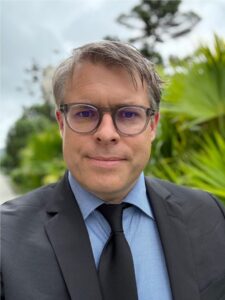
Prof. Dr. Christian Montag works at the intersection of psychology, neuroscience, behavioral economics and computer science. He is particularly interested in digital phenotyping, mobile sensing, and digital biomarkers. Moreover, he studies technological use disorders and attempts to understand how social media can be improved. In his most recent works, he focuses on the question on how interaction with AI impacts on the human mind. Christian Montag received his diploma in psychology in September 2006 (University of Giessen, Germany). In 2009, he achieved his PhD, and in 2011, the venia legendi for psychology (University of Bonn, Germany).
Since April 2025 Christian Montag is Distinguished Professor for Cognitive and Brain Sciences and Associate Director of the Institute of Collaborative Innovation at University of Macau, Macau SAR, China. From September 2014 to March 2025, he was a Professor for Molecular Psychology at Ulm University, Ulm, Germany (W3). From September 2023 to October 2025 he was also Adjunct Professor at Hamad Bin Khalifa University in Doha, Qatar. From to 2016-2022 he was an Agreement-Professor at the Neuscan lab at the University of Electronic Science and Technology of China in Chengdu, China. He is a (co-)author of more than 450 peer-reviewed international papers and currently serves on the editorial board of the journals Personality Neuroscience, Telematics and Informatics Reports, and Addictive Behaviors. He is a co-editor of the book series “Studies in Neuroscience, Psychology and Behavioral Economics” at Springer. His current H-index is 93 and his works have more than 30.000 citations according to Google Scholar (13th January 2026). Christian Montag belongs to the World’s Top 2% Scientists according to the list of Stanford/Elsevier published in 2025.
.